What's going on?

Upcoming/New

  • I'll be on a research visit to University of Waterloo from April to August 2026. Let's meet up or catch up if you are around!
  • Our latest paper, "Data-driven conflict classification exposes weak predictive indicators" is out now in Royal Society Open Science! [Paper] [Dataset] [Code]

Past

  • December 2025: I won the yrCCS Bridge Grant 2025. [Website]
  • August 2025: I was the runner-up winner of the "Bertalanffy Doctoral Student Award 2025". [Website] [Video presentation]
  • July 2025: I gave a talk at the International Conference on Computational Social Science (IC2S2) 2025 in Norrköping, Sweden. [Website]
  • July 2025: Was invited as a special delegate to the "AI for developing countries forum (AIFOD)" 2025 at the United Nations, Vienna. [Website]
  • June 2025: Presented a poster at the Circle U. Climate Day 2025 in Vienna, Austria. [Website]
  • March 2025: Gave a talk at the German Physics Society conference 2025 in Regensburg, Germany. [Website]
  • March 2025: Gave a talk at the workshop on "Understanding Democratisation and Civil War with Statistical Physics" in Vienna, Austria. [Website]
  • January 2025: Gave a talk at the NetSciX 2025 conference in Indore, India. [Website]
  • August 2024: Gave a presentation at the United Nations Office on Drugs and Crime (UNODC) in Vienna, along with my colleagues. [Website]
  • July 2024: I was invited as a participant in the "AI for developing countries forum (AIFOD)" 2024 at the United Nations, Vienna. [Website]
  • April 2024: I was on a short research visit to Prof. Karoline Wiesner's lab at Potsdam, Germany. [Website]
  • March 2024: Gave a talk at the German Physical Society meeting 2024 in Berlin. [Website]
  • October 2023: Gave a talk at the Conference on Complex Systems (CCS) 2023 in Brazil. [Website]
  • August 2023: Our work was mentioned in the article "The Military’s Recruitment of AI Has Already Begun" published in The Daily Beast. [Article]
  • August 2023: Our paper was featured in Sabine Hossenfelder's science news. [Youtube video]
  • August 2023: Gave a live interview at the BBC newsday radio show. [Website]
  • August 2023: Our Python package for generating conflict avalanches is out now. [Github]
  • August 2023: Our paper entitled, "Discovering Mesoscale for Chains of Conflict" is out in PNAS Nexus. [Paper] [Our dataset] [Press release]
  • July 2023: Attended the Lipari School on Computational Complex and Social Systems 2023 in Lipari. [Website]
  • July 2023: Attended the NetSci conference 2023. Participated as a volunteer and helped in the organization of the conference. [Website]
  • May 2023: Won the ”Significant Milestone Award of the 2023 Exner Lectures in the category of PhD”. [Website]
  • March 2023: Gave a talk at the German Physics Society meeting 2023 in Dresden. [Website]
  • December 2022: Preprint for my work on conflict mesoscales is now available.
  • October 2022: Gave a talk and presented a poster at the Conference on Complex Systems 2022 in Palma de Mallorca. [Website]
  • September 2022: Gave a talk at the German Physics Society meeting 2022 in Regensburg. [Website]
  • July 2022: Attended the Lipari School on Computational Complex and Social Systems 2022 in Lipari. [Website]
  • July 2022: Attended the BIGSSS summer school in computational social science 2022 in Groningen. [Website]
  • August 2021: Started PhD at the Complexity Science Hub Vienna and the department of physics of University of Vienna.

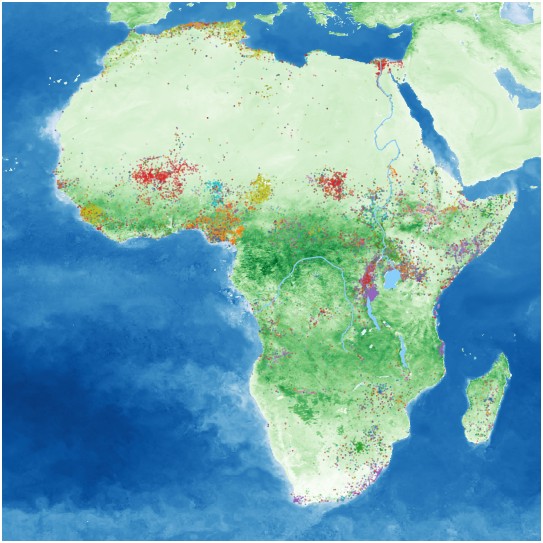
The Triangle of Madness

What if conflicts could be grouped into a few fundamental types? This study uses a data-driven approach to reveal three archetypal forms of armed conflict across Africa—while also showing why even rich data can fall short when predicting how severe conflicts will become.

Synchrotron Emission from Supernovas

High-energy cosmic particles reveal themselves through the light they emit while spiraling through magnetic fields. This project explores how synchrotron radiation changes when those fields are non-uniform, offering a more realistic window into how astrophysical sources like supernova remnants and nebulae shine.

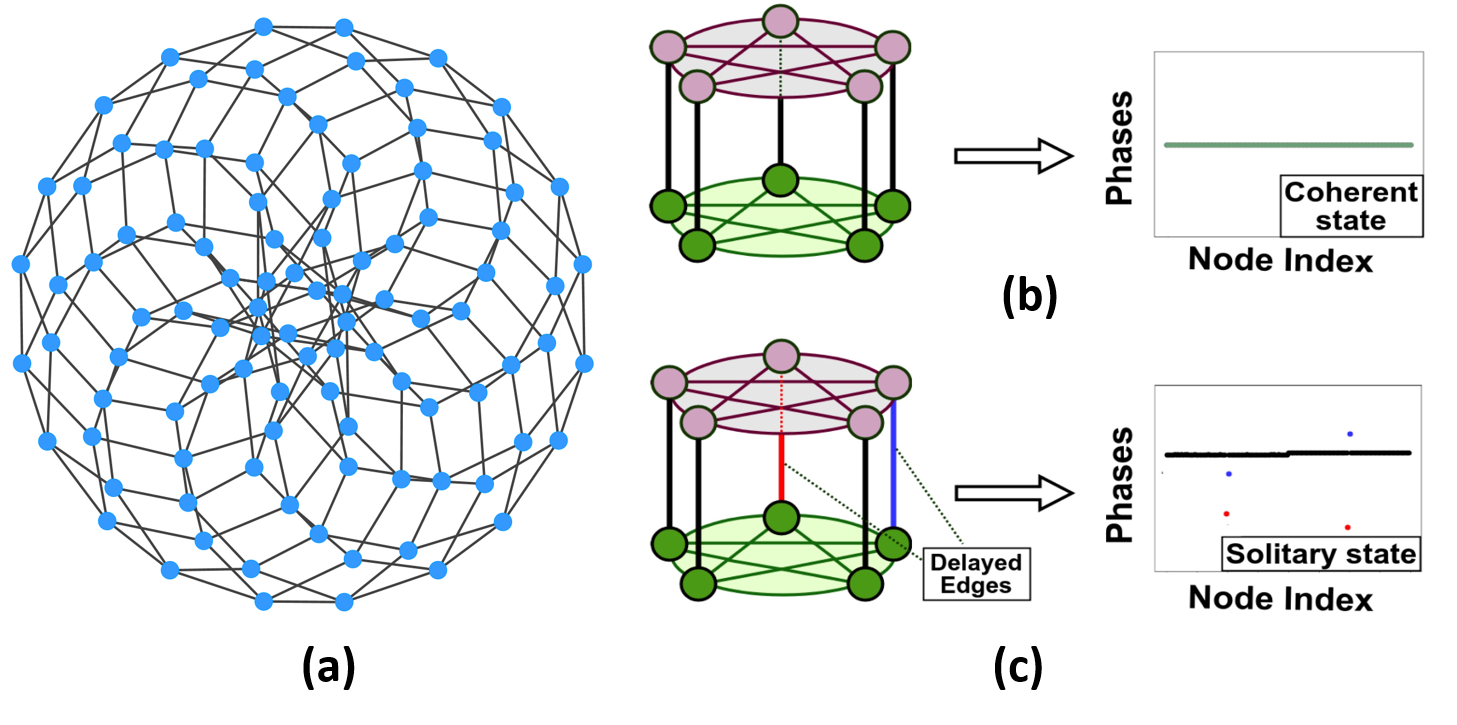
Rippling Chimera in Oscillator Networks

Chimera states—where coherence and incoherence coexist—are among the most intriguing behaviors in complex systems. This work demonstrates how machine learning can reliably predict the delays needed to create these states, bridging theoretical dynamics and experimental design.

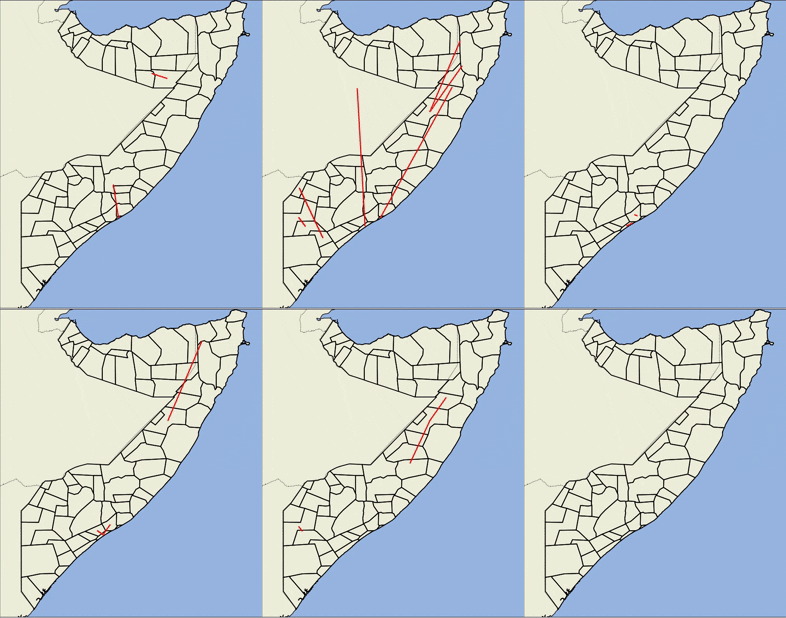
Armed Conflict Avalanches and Mesoscale

From single incidents to regional crises, conflicts form connected chains rather than isolated events. This work reveals a hidden scale at which these connections— unfolding as conflict avalanches—become visible, offering a new way to study, interpret, and eventually anticipate the dynamics of armed conflict.

Population Waves in Sessile Organisms

Life follows striking mathematical patterns, from metabolism to population size—but real ecosystems are shaped by competition and limited resources. This work aims to show how accounting for these interactions reveals mechanisms behind population oscillations and ecosystem instability. (PROJECT CURRENTLY ON HIATUS)

Other Small Projects

Schelling's Agent based modelling, ML model for crop detection using satellite images, ML model for credit card fraud detection


Publications

    1) Niraj Kushwaha , Woi Sok Oh, Shlok Shah, Edward D. Lee, Data-driven conflict classification exposes weak predictive indicators. R Soc Open Sci. 1 December 2025; 12 (12): 250897.
          https://doi.org/10.1098/rsos.250897

    2) Niraj Kushwaha , Edward D Lee, Discovering the mesoscale for chains of conflict, PNAS Nexus, Volume 2, Issue 7, July 2023, pgad228.
         https://doi.org/10.1093/pnasnexus/pgad228

    3) Kushwaha, N., Mendola, N. K., Ghosh, S., Kachhvah, A. D., & Jalan, S. (2021). Machine learning assisted chimera and solitary states in networks. Frontiers in Physics, 147.
         https://doi.org/10.3389/fphy.2021.513969


Coding packages and datasets published

    1) Python package to generate conflict avalanches for any given spatial and temporal scale
         https://github.com/eltrompetero/armed_conflict_avalanche

    2) Python package to harmonize geospatial datasets and generate systematic clusters of input armed conflict data
         https://github.com/NirajKushwaha/traingle_of_madness

    3) Dataset of armed conflict avalanches and reusable Voronoi grids which can be used for wide-variety of spatial analysis over Africa
         https://zenodo.org/records/8117567